
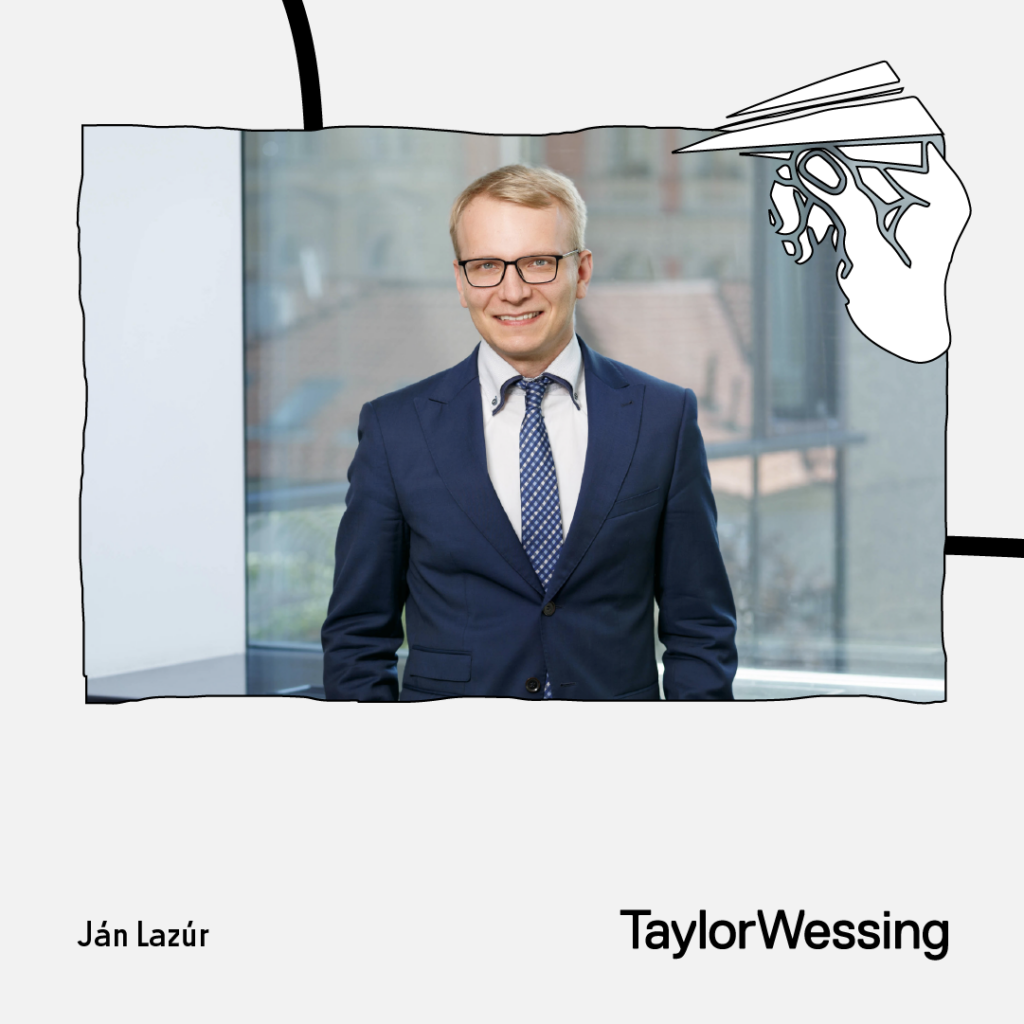
“Law and art may be two worlds that seem different at first glance, but they are united by their ability to shape reality – one through rules, the other through artistic experiences and emotions. Both have a common foundation – they open up enormous space for human creativity. The project Do You Have an Artistic Gut? is, for us, an exceptional moment of an interesting connection between these two worlds. We are very pleased about the collaboration, because the project gives young people space to gain new experience and carry out free creative decisions. We are glad that we can be part of it again this year,” comment Ján Lazúr and Zoltán Nagy, lawyers at Taylor Wessing, on the collaboration.
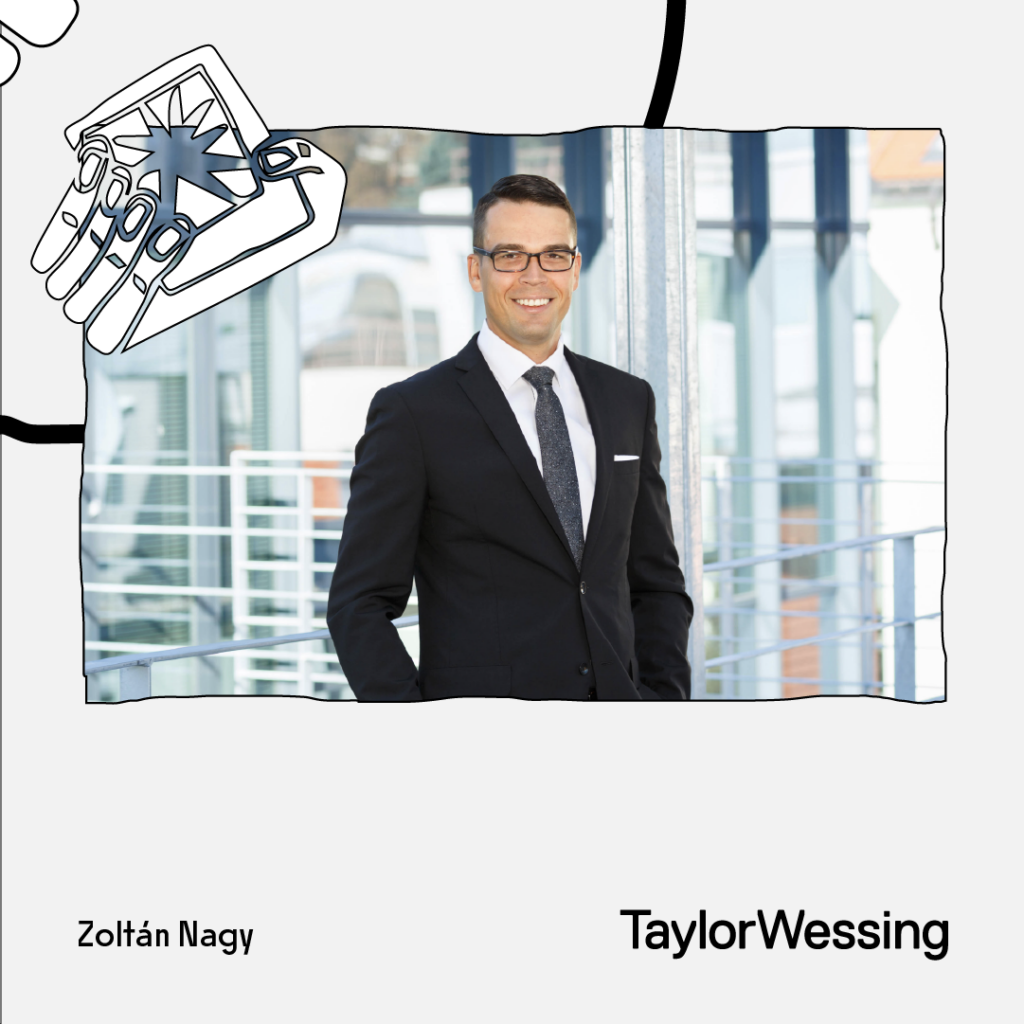
With Ján Lazúr and Zoltán Nagy, lawyers at Taylor Wessing, we have prepared an online lecture with discussion for you this year, which will address practical questions about how to consider legal risks and use sharing platforms effectively, without losing the value of or control over your content. We will also reflect on the issues of sharing privacy, creating digital footprints, and the impact of AI on the creation and value of content. At the end, there will be space for questions from practice!
Already on 27 January from 16:00 online via ZOOM; registration is possible via the form. The event is free of charge, intended primarily for young people aged 14–19, but we will also gladly welcome the general public.
Both Ján and Zoltán provide advisory services to domestic and foreign clients from various artistic and technical sectors. Copyright law and law in the field of new technologies are among their favorite disciplines in particular.
How did it begin? Radovan Pala, one of the founders of the Taylor Wessing law firm, decided four years ago to start supporting the project Do You Have an Artistic Gut?, which runs under the SNG. He liked it because it supports curiosity, creativity, reflection on current issues, as well as the ability to collaborate and bring things to completion. We sincerely thank both Taylor Wessing partners, Radovan and Andrej Leontiev, for their support. Taylor Wessing is an international law firm focused on commercial law and intellectual property law, which is one of the key tools for supporting creativity in society and among individuals. Sharing and protecting innovation is key for both sectors.
…
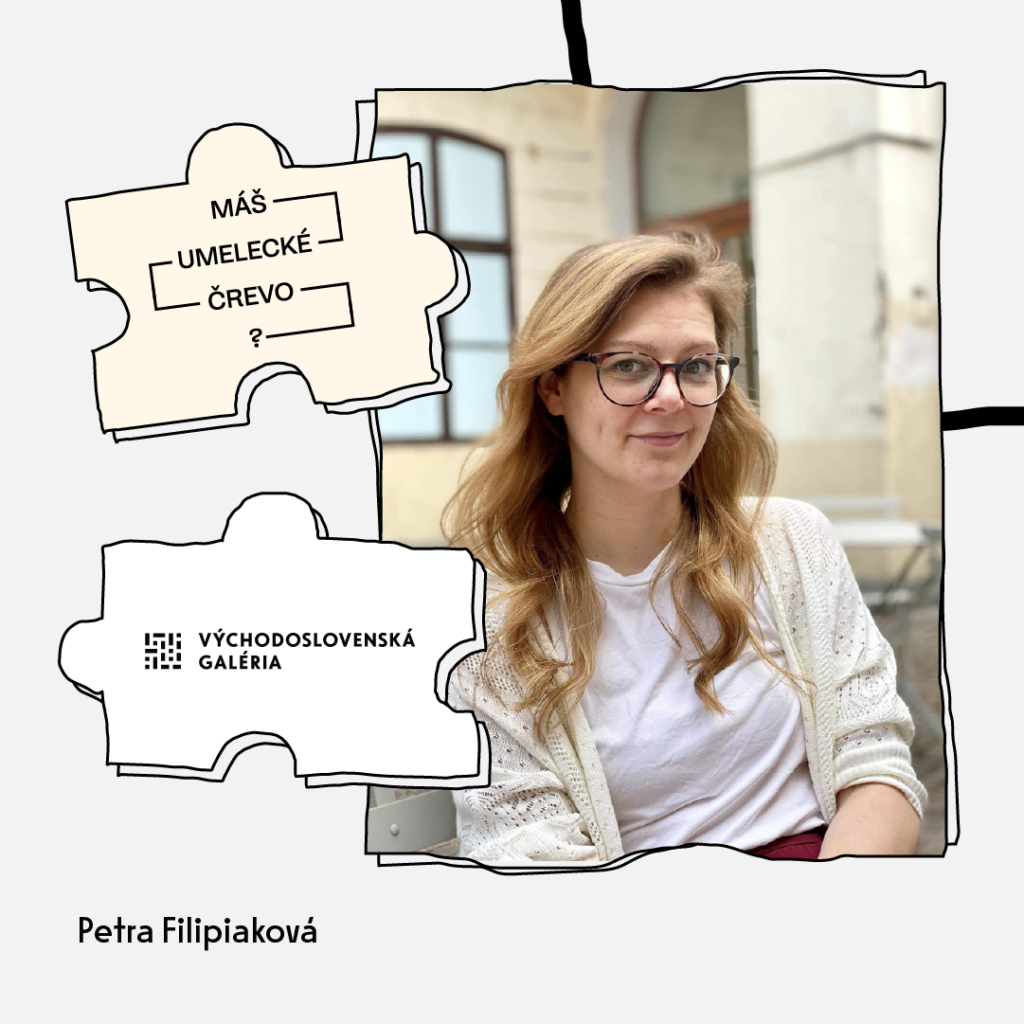
After the relaxing holiday break, we are slowly getting back into motivational patterns. Since the beginnings of the competition, we have been trying to bring Gut to different parts of Slovakia thanks to partnerships with regional galleries. So we asked representatives of the partner institutions what Gut brings them.
Photo: Jakub Gyulás

…

The goal of IPčko is for people who find themselves in difficult and crisis situations to have anonymous professional psychological help and support available around the clock. In fulfilling this goal, they use and connect the latest psychological knowledge with modern technologies. A crisis helpline is available via chat, e-mail, video and telephone at 0800 500 333, as well as in person at 9 centres of informal psychological help for young people: Káčko in Bratislava, Nitra, Trnava, Žilina, Trenčín, Banská Bystrica, Prešov, Michalovce and Košice. These centres also include IPčko’s mobile Crisis Intervention Team, which provides help directly in the field. Young people can also connect with the IPčko team through online communities on Twitch on Sunday evenings (around 7 p.m.) during the live stream Is Your Soul Whistling? Ask the Soul Experts, as well as on Discord, where they are available from Monday to Wednesday (19:00–21:00), and where, in addition to help, you will also find a self-development programme focused on various topics. You can find out more about IPčko at www.ipcko.sk
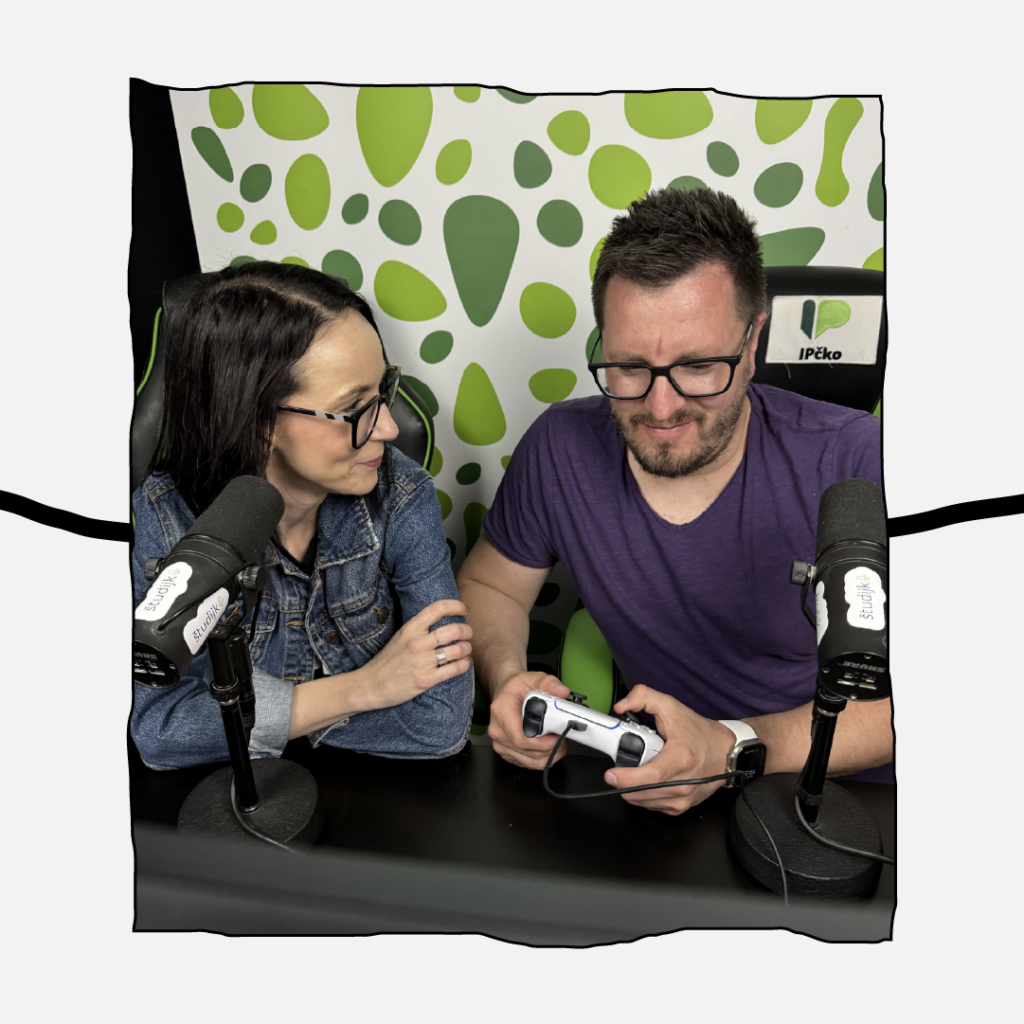
Art, or the opportunity to take part in an art competition, and psychological help have in common that they provide space to communicate one’s experiences. Art is precisely the way in which we express our emotions, feelings, needs and desires outwardly. Zuzana Juráneková, an expert counsellor from IPčko, sees the connection between art and mental health “as a good way for us to reach young people, show them that help exists, and support them so that they do not remain alone with what they are experiencing in their lives. The platform Do You Have an Artistic Gut? connects young people, supports their creativity, and wants to hear their statements and opinions. It is very important for young people to feel that someone is truly listening to them, and the platform wants to listen to them through art. Together, we are creating a safe place for them for respectful dialogue, self-realisation and development. At the same time, in this way we can also jointly fight the myths, prejudices and stigma associated with the topic of mental health and pass on information and recommendations on how to cope with situations that arise in life.”
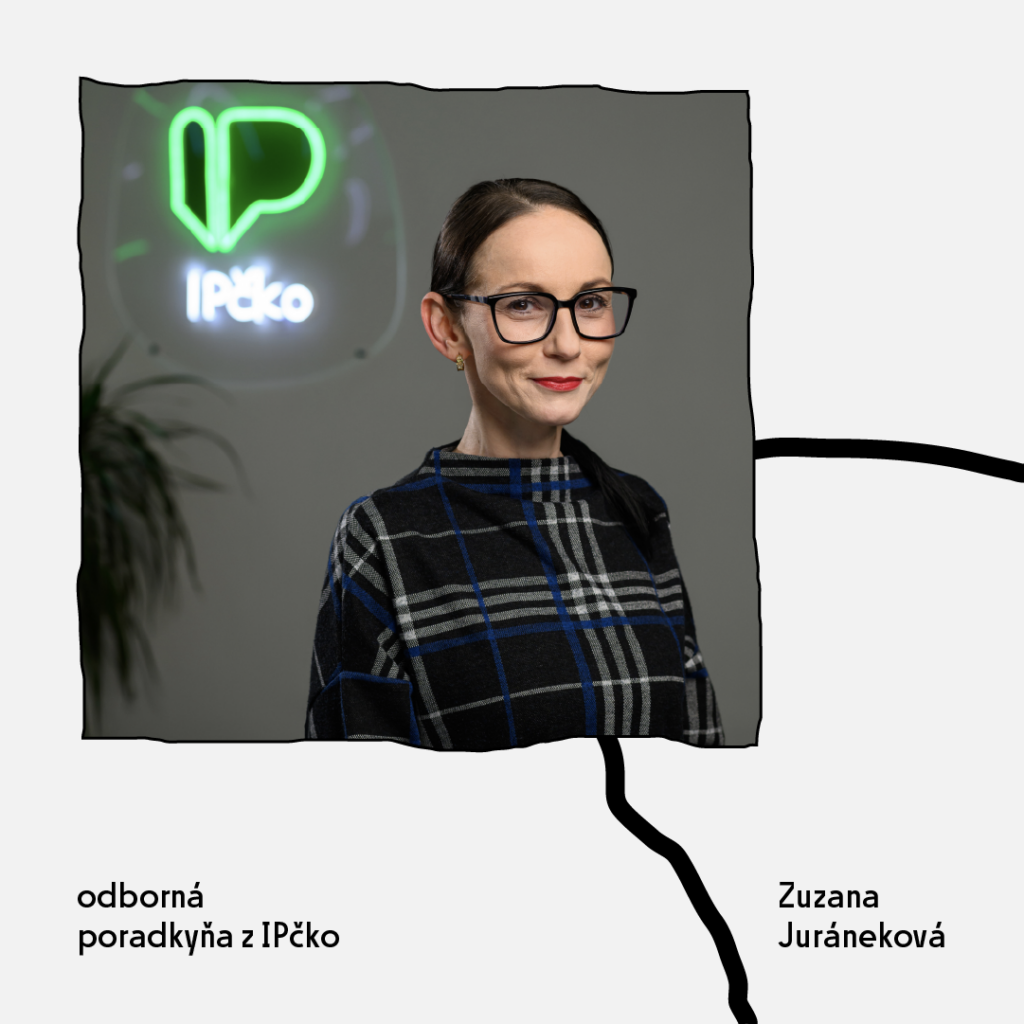
Zuzka is part of IPčko’s mobile Crisis Intervention Team, which comes to a person in crisis. For a long time, she worked on the border between Slovakia and Ukraine, where she provided psychosocial help and support to people affected by the war conflict. Together with another colleague, she looks after 9 Káčko crisis intervention centres across Slovakia, and for a time she also “adopted” the ID KLUB in Nitra, where she can meet young people and be really close to them. She is currently working intensively on the Online Outreach Work project, which focuses on actively mapping the online environment, identifying at-risk groups, providing support and help to people in these groups, internet phenomena, and creating helping content on the topics of mental health and the online environment.
…

Photo: Peter Kmeť
Katarína is a graduate of VŠVU / AFAD in painting, an artist working in the field of visual art and literature, and until recently she also worked as a teacher at a secondary art school. She is based in Bratislava, and soon you will be able to meet her at workshops both in person and online!





Thank you to Katka for the interview. You can also find out more on her website: www.katarinapol.com
…
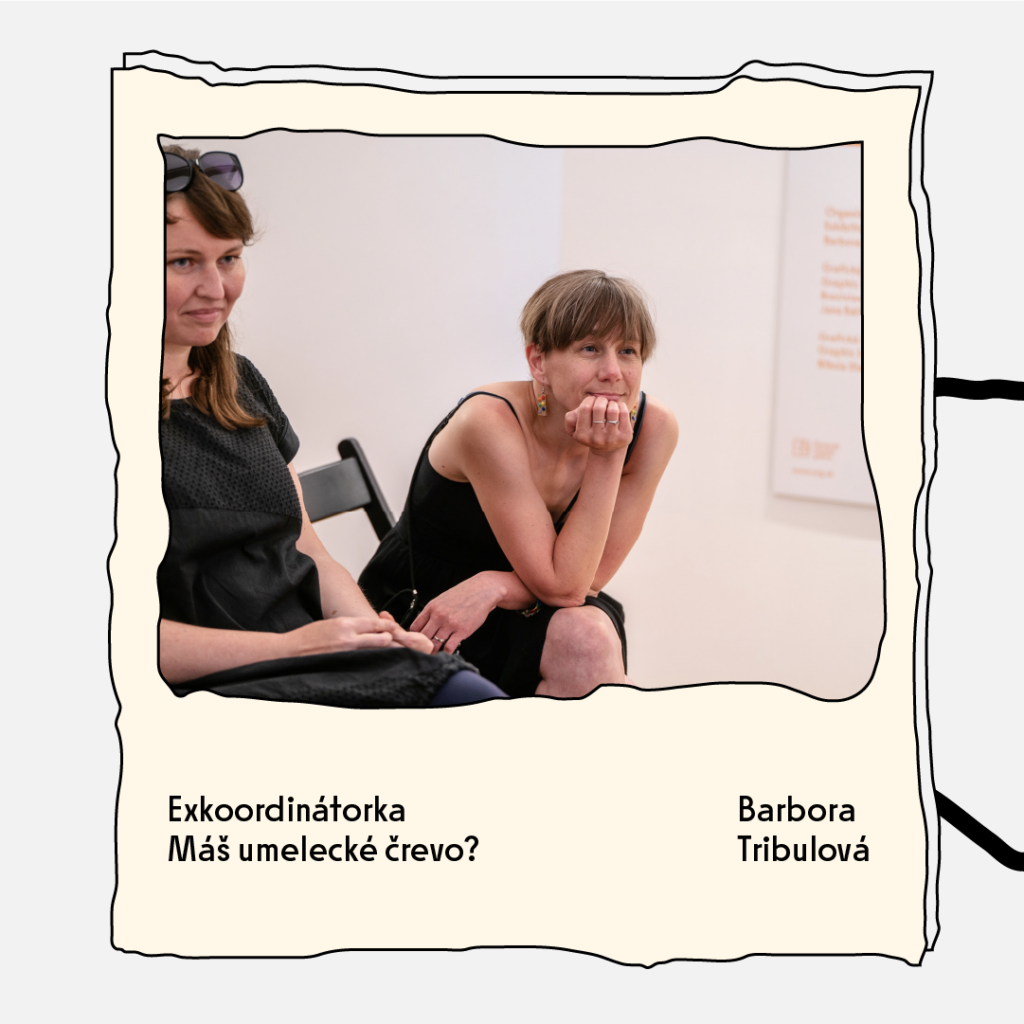
The new edition has come with a change in the platform’s leadership. Today, we have therefore prepared for you a short dive into the beginnings of Črevo in Slovakia with former coordinator Barbora Tribulová from SNG – Slovak National Gallery.
…
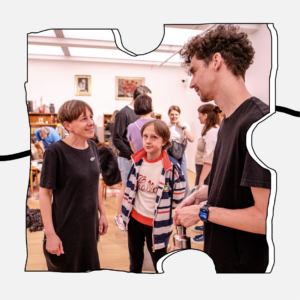
We have successfully completed the exhibitions! Designer Andrea Ďurianová contributed to their architecture, joining the team just before the semifinal, when she replaced Braňo Matis. Her acclimatization was therefore very quick.
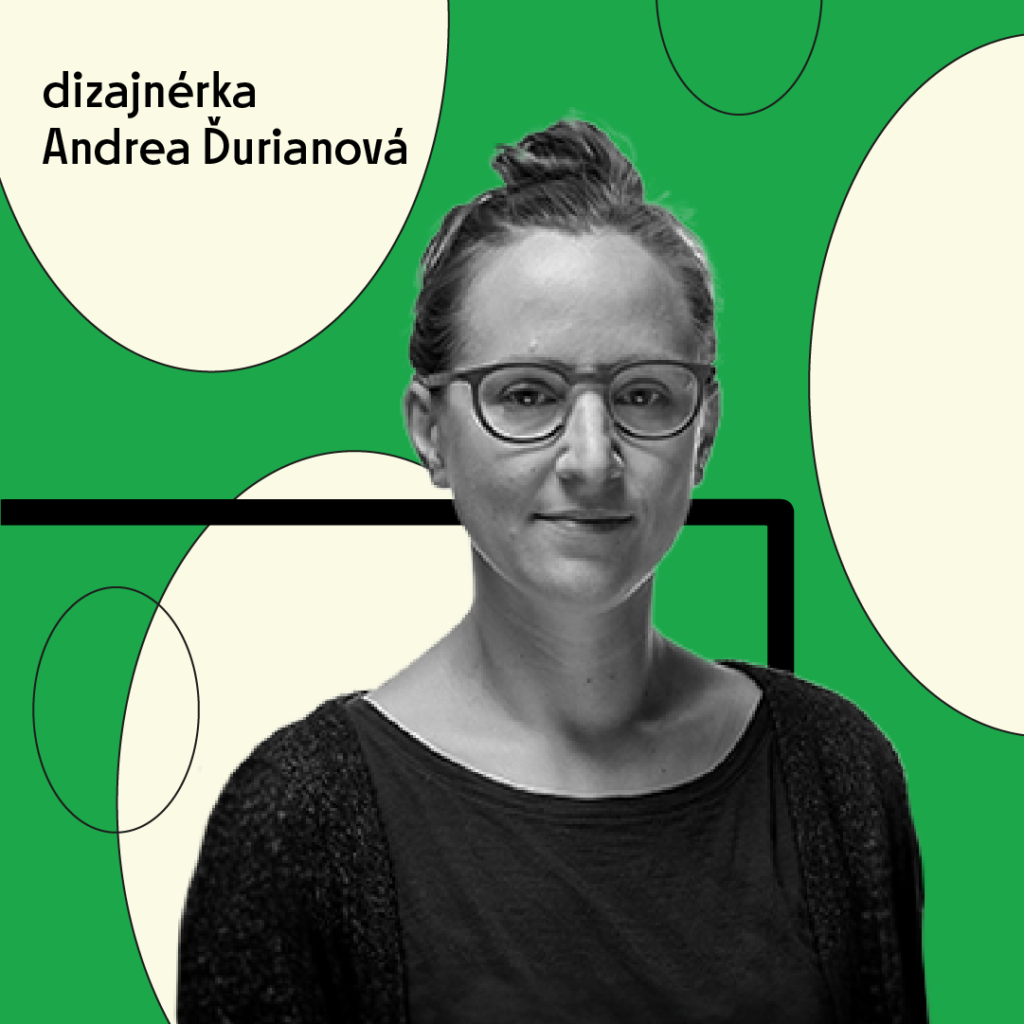
Andrea lives in Bratislava, mainly focusing on designing and implementing exhibition architecture, but also on designing and creating awards or jewellery. She got into exhibition design gradually; after finishing university she started as a so-called exhibition arranger at ÚĽUV, or carried out small-scale solutions for displaying exhibits at the Slovak National Museum. At that time, she began to take a focused interest in exhibition-making and gradually got involved in various projects.
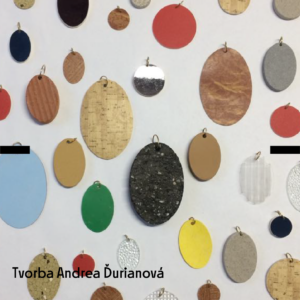
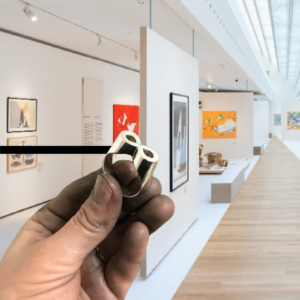
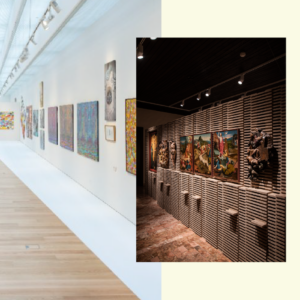
She got into jewellery-making while still “at home” as the daughter of a jewellery maker and goldsmithing teacher at ŠUP in Kremnica. What she enjoys most about jewellery is the craft – in the sense of the ability to create something, to have the process in her own hands and at the end to hold an object made of material. For Andrea, creating an exhibition is about space, given possibilities, but also arrangement. An exhibition is a work in which many individuals, as well as objects, take part, and what Andrea enjoys about it is that she is part of a team. The project gradually crystallizes into the final result.
“Taking part in the preparation of this year’s exhibition Máš umelecké črevo? surprised me above all with the complexity of this project, where the competition is structured as a set of various activities with students and the exhibition is the culmination of a several-month-long project. It was interesting for me to watch how the teams developed their works and at what a high verbal and technological level the presentations were. As for the exhibition itself, the conditions for its implementation were more than standard – we had the national gallery’s exhibition hall at our disposal, including the technical team; everything was perfectly prepared and secured. So I really enjoyed this type of collaboration,” Andrea concludes her recap of the process.
You can find more of Andrea’s work at www.andreadurianova.sk or on IG @andreadurianova
…
As the Máš umelecké črevo? platform develops, so does its visual side. Since we focus on educating young people, we decided to give space to more talented students from the Department of Visual Communication at VŠVU. This year, our team was strengthened by Sofia Kuželová, who took over the baton of our social media visuals from Adrián Dvorský, whom we warmly greet! We are happy to give space to talented people in this way.

Sofia comes from the area around Prievidza, where she also attended secondary school – a grammar school. She is currently a second-year student of Visual Communication at VŠVU. Alongside school, Sofia also tries to devote herself to graphic design, though so far mostly through smaller commissions. Otherwise, you’ll find her making coffee in one of Bratislava’s hipster cafés.
Sofia began working in graphic design, so to speak, by chance, because when she applied to VŠVU after deciding that architecture was not for her, she knew very little about what this field involved. This change excited her, but she still needs to become a little better friends with graphic design. For now, she has not defined what exactly she would like to do or what she enjoys… At the moment she is in a phase of discovery and experimentation. So we’ll see how it all turns out in the end! Surely brilliantly.
You can follow Sofia’s world here: @sof_kuzelova
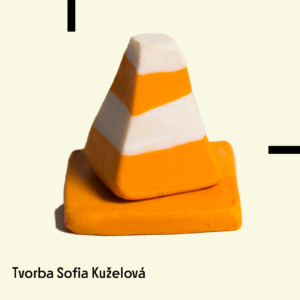
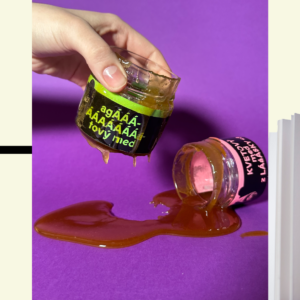

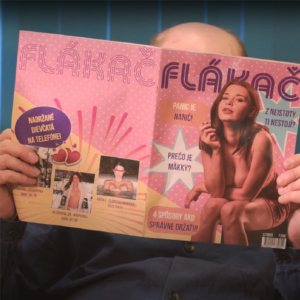
Not only for us, but also for Sofia, the collaboration on Črevo is new. She took it on also because she likes challenges. Of course, the beginnings gave her a hard time and can still give her a hard time. When she hears the word net, Sofia immediately thinks of a fishing net, but she has no relationship with that and fishing probably doesn’t appeal to her either. As for social networks, she uses Instagram the most, but she cannot say she loves it. Lately she feels that it takes up more of her time than it realistically should.
Thank you to Sofia for giving us insight into her corners and for the honesty with which she told us about herself. We are excited about this collaboration!
…
Our collaboration with Taylor Wessing Bratislava continues! The Máš umelecké črevo? competition and our activities appealed not only to Radovan Pala, but also to Andrej Leontiev – the second of Taylor Wessing’s managing partners. We would like to introduce him to you.


Inspired and enthused by this year’s theme, Andrej and Radovan are currently trying to secure support for next year’s edition and to “network” the project with teams in the offices in Prague and Budapest as well. It would be great to connect cooperation at an international level not only on gallery ground, but also in the legal field!
In addition, we are very pleased that Do You Have an Artistic Gut? is inspiring the Taylor Wessing team toward curiosity and civic responsibility in the reconstructed premises of their office, in the form of posters from recent years!
Taylor Wessing is an international law firm focused on the industrial and creative sectors of the future. For these sectors, sharing and protecting innovations is key. In addition to commercial law, Taylor Wessing lawyers therefore also focus on intellectual property law, which is one of the key tools for supporting creativity in society and among individuals. If an author is guaranteed personal and property rights to the results of their creative activity, they are more motivated to bring their ideas to completion not only in creative work, but also in business.

…
 Photo: Boris Németh
Braňo was born in Martin, graduated from the Secondary School of Applied Arts in Košice, and completed his master’s studies at the Academy of Fine Arts and Design in Bratislava. He then spent 4 years working in studios and publishing projects in Prague, and in 2009 returned to the Academy of Fine Arts and Design for doctoral studies, which he completed with a dissertation on participatory design on social platforms — primarily about the older network Myspace.
Currently, alongside his work at the SNG and teaching at the Pan-European University and the Academy of Fine Arts and Design, he focuses on the design of cultural projects, exhibitions and publications, and occasionally works as a lecturer and author of texts on design. He received the National Award for Communication Design in 2013 and 3 finalist nominations in 2016 and 2020. In addition, he co-organised the Kupé graphic designers’ conference, several activist workshops and critical projects in Slovakia and Czechia (On/Offline Rendezvous, Living Underground, Living Vandalism, Open Neon, Visible Data, Data:Democracy, Dyktát Bruselu and Železo, zamat, nožnice).
For Braňo, one of the key layers of meaning in visual communication is that it should be “food for the mind, the soul, etc. — and not just a stimulus for the receptors, although that too is an important part of its effect,” he adds. Braňo tries to draw viewers into a game of interpretations and the search for meaning (quite possibly a completely different one from what he had in mind). That is why, as a designer, he often makes life more complicated for himself and stretches out the time needed for implementation with concepts hidden behind the visuals, which some, perhaps even most, of the audience will probably not notice. But for him it is worth it!
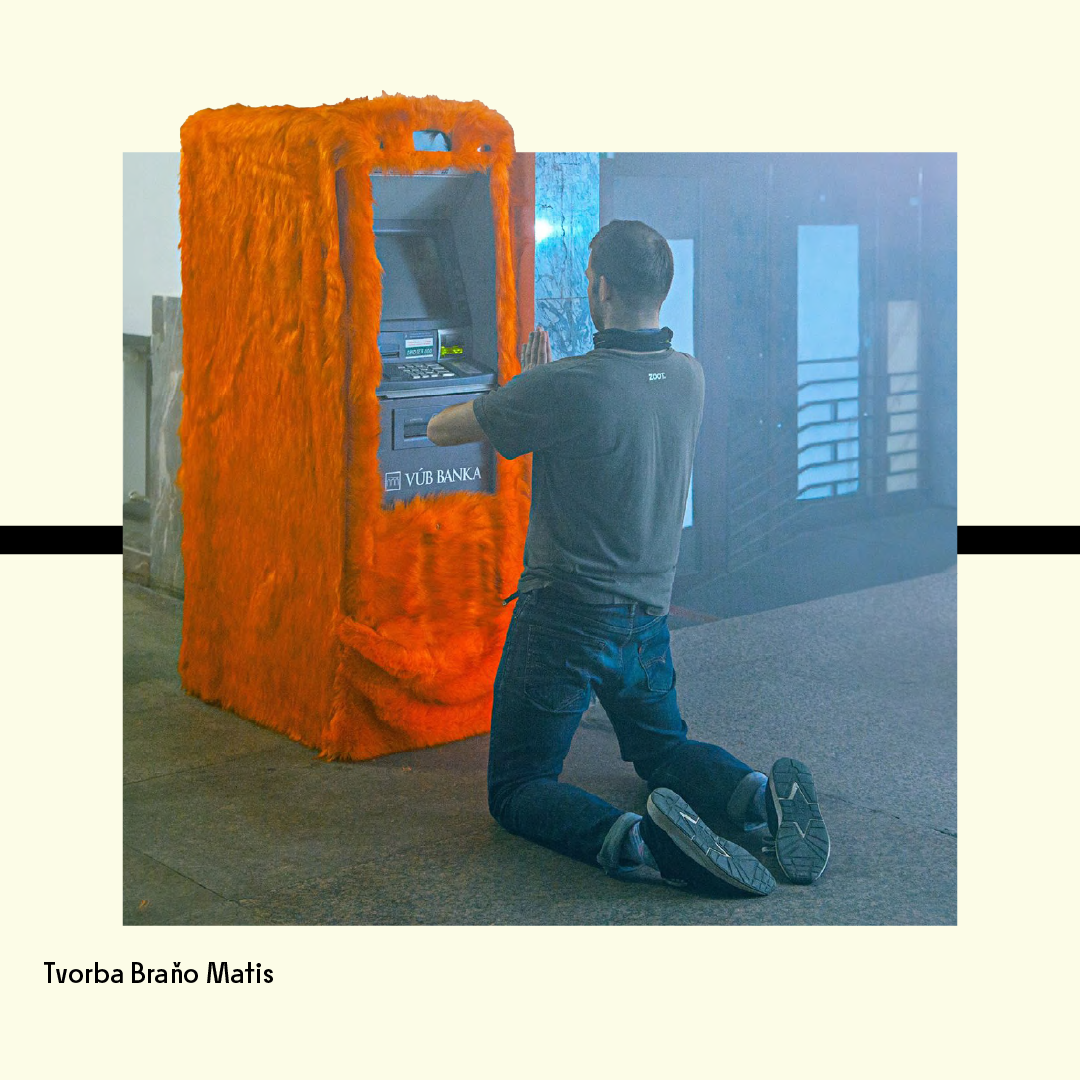
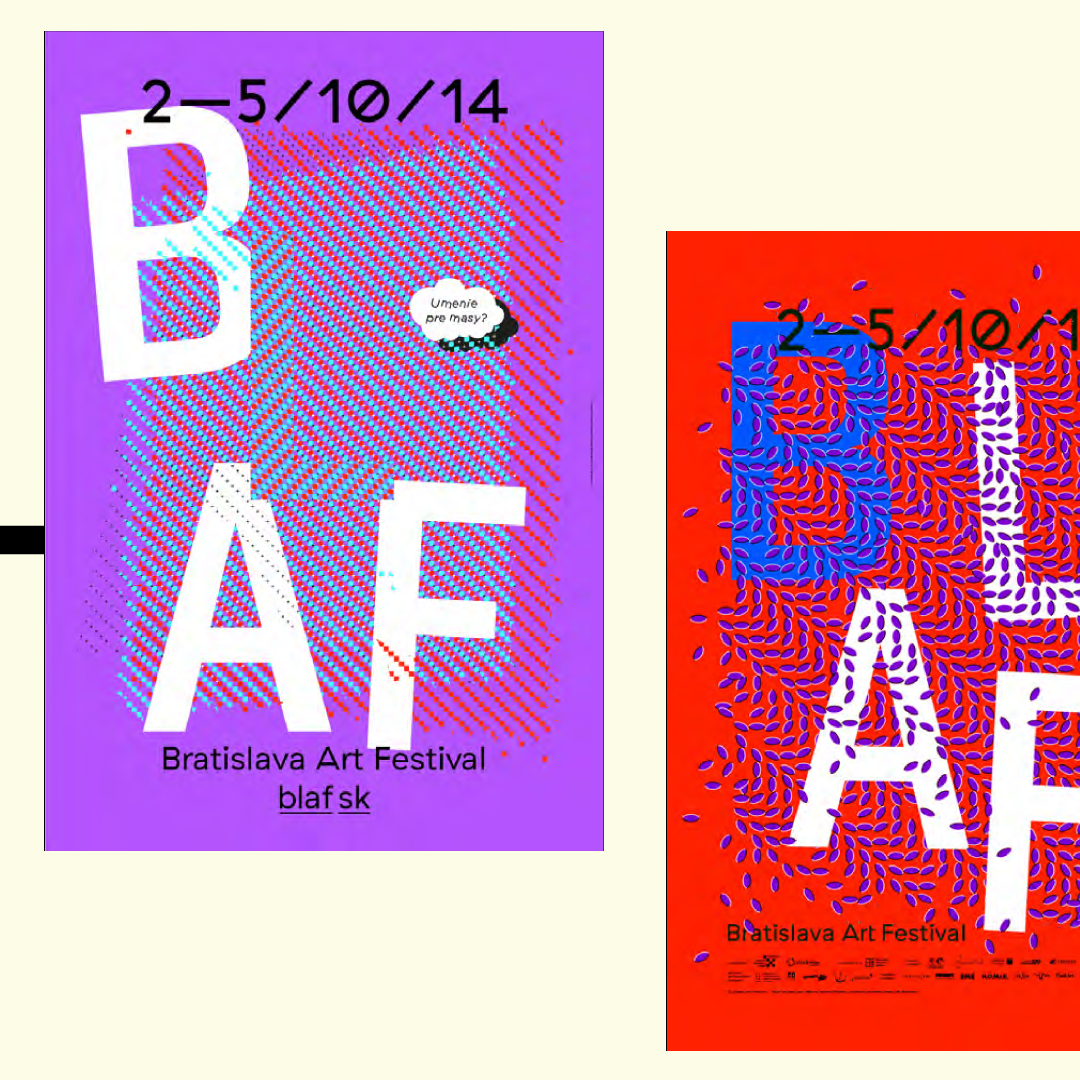
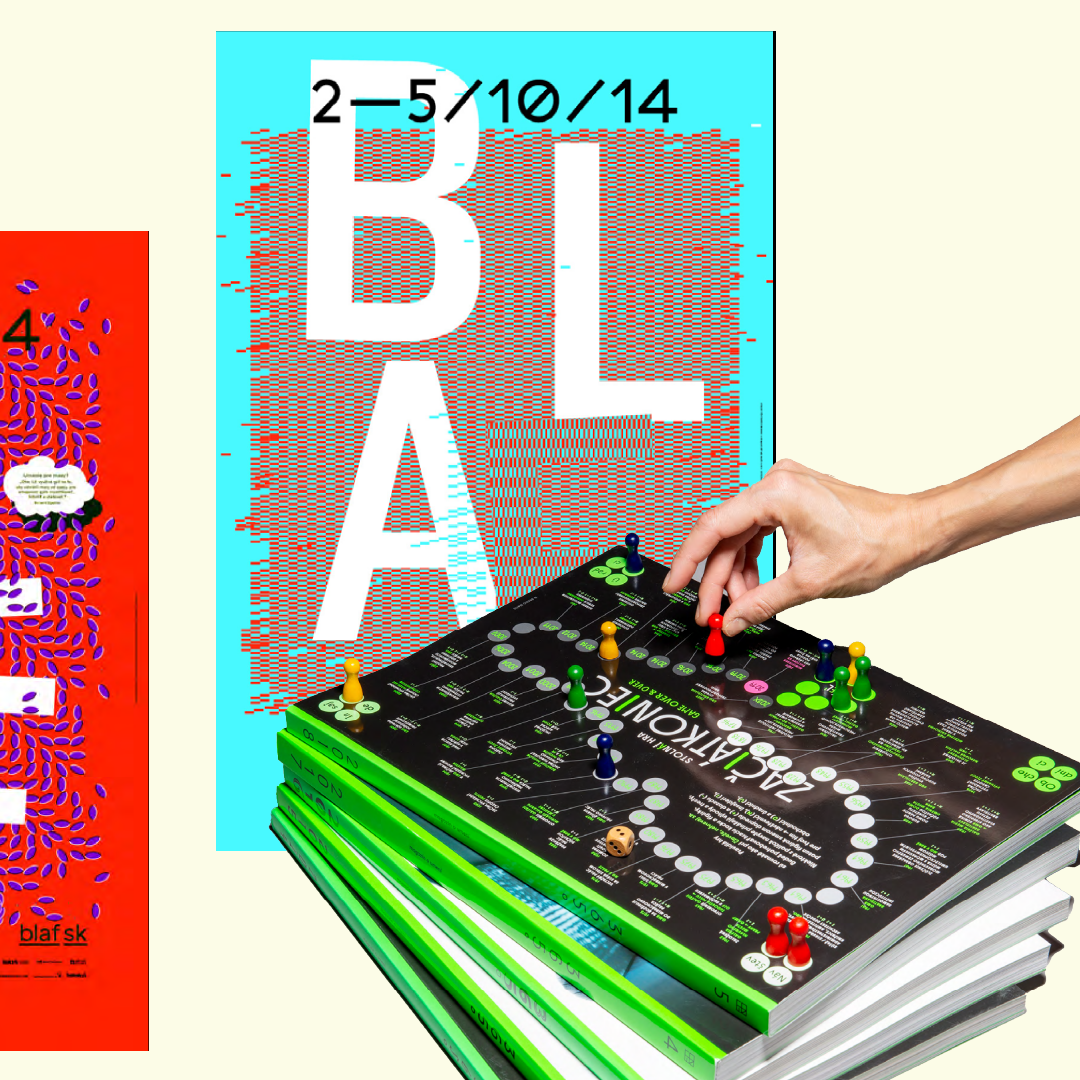

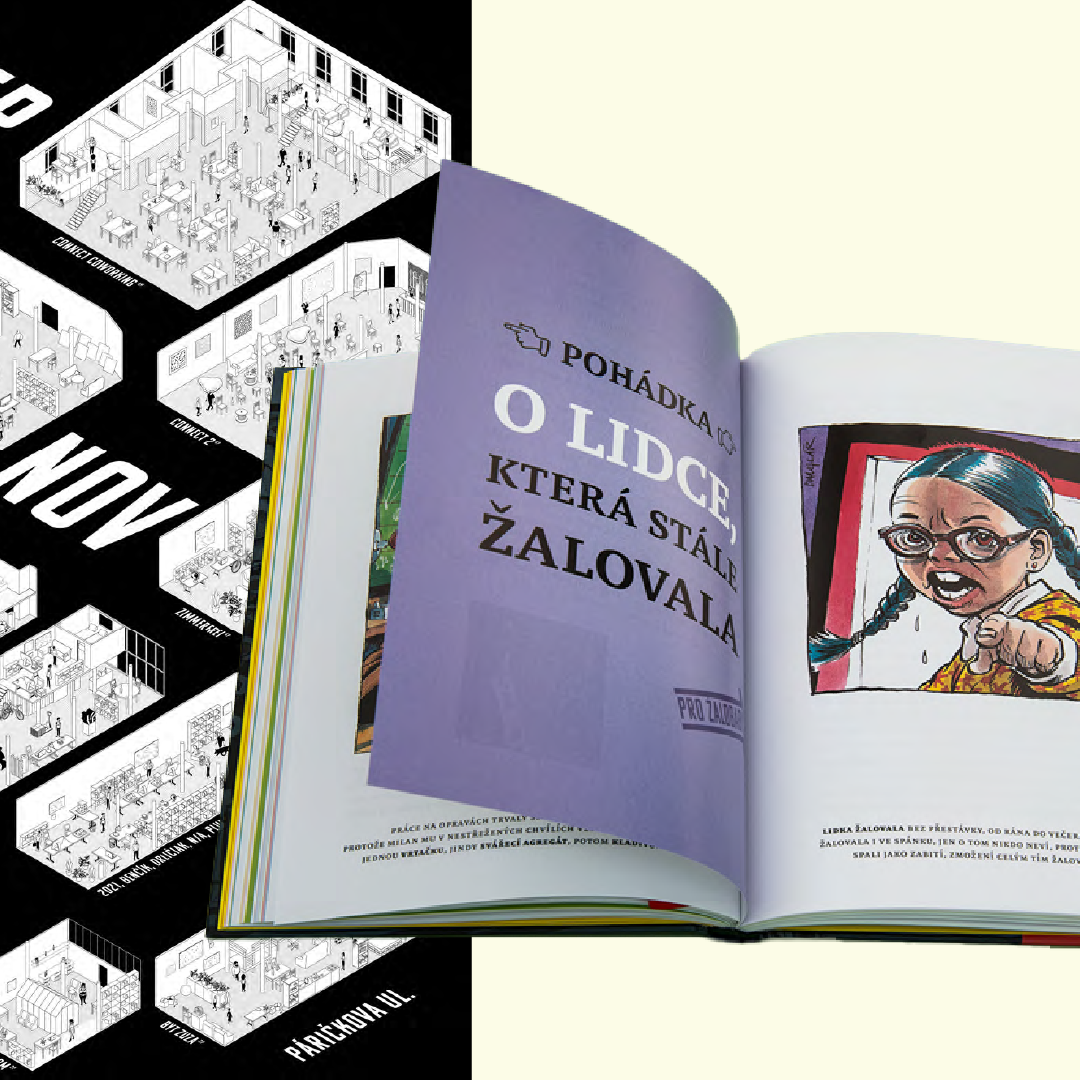
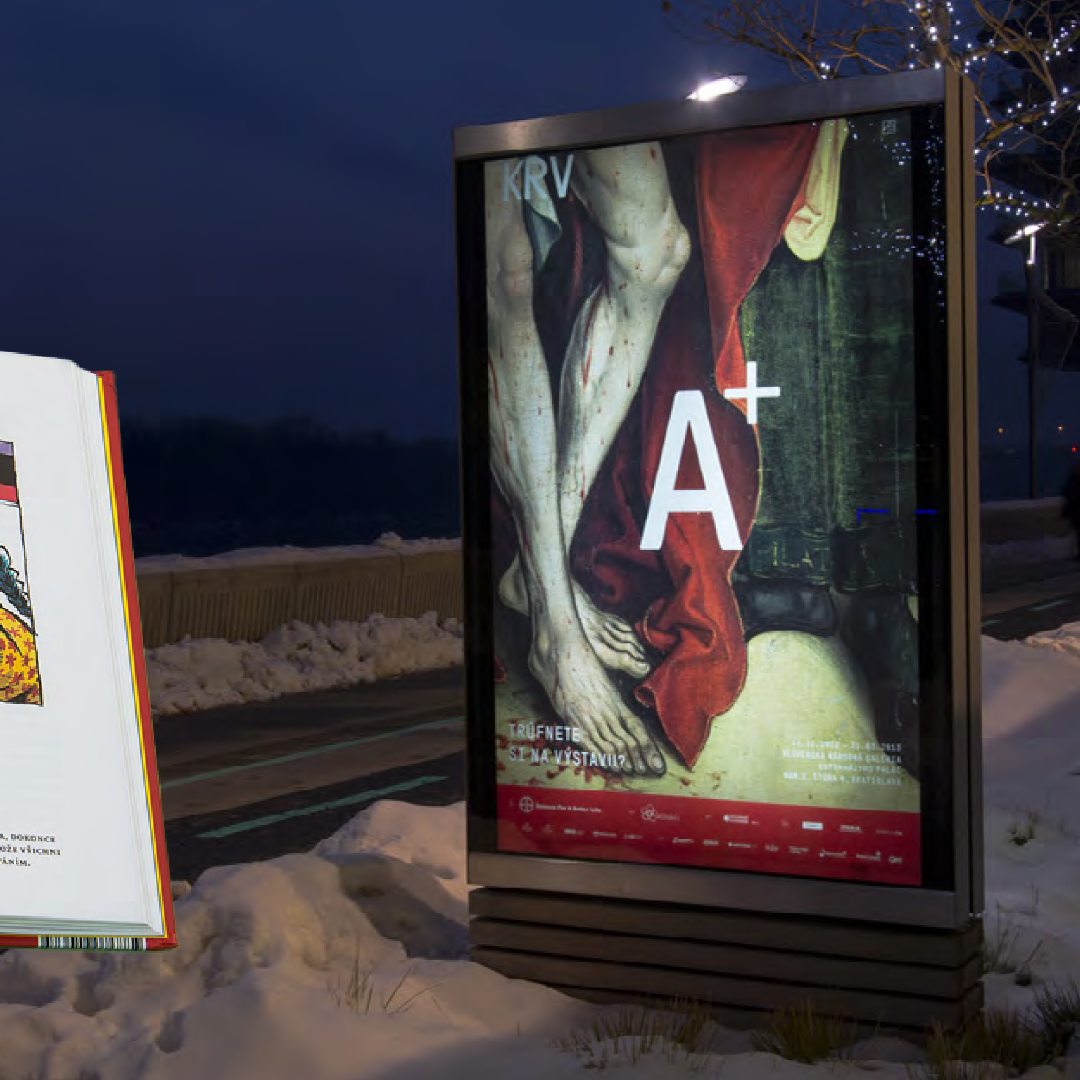
Braňo’s work could be described as engaged, because in influencing the audience it seeks to change society itself. “It is a task similar to emptying the ocean with a spoon; its end is always out of sight.” In doing so, he uses a very diverse range of means, from graffiti on a fence, through inserting political content and designs for techno events, to efforts to influence the production of promotional materials and publications with regard to their carbon footprint (so that less is printed, or perhaps on better paper). Some designs are more adrenaline-filled than others, but Braňo tries to use the whole range of them and, above all, not to get too comfortable and to remain active. He himself does not understand how it is possible that he still enjoys design, and he hopes that the rise of artificial intelligence will not harm his field. In the past, however, he briefly worked in fast food, which represents one of the fallback and always current employment options.
A portfolio has long been Braňo’s weaker point, as he does not enjoy returning to problems that have already been solved, but you can see something here: https://drive.google.com/file/d/1M6xpl3-_sUE81GVa36FrpzevPmlABX5G/view?usp=sharing You can find a lot of his work, in tandem with Pavlína Morháčová, Bea Paňáková, and also independently, at the SNG in Bratislava.

Braňo’s role in the Črevo team is key if we want to give space to young graphic design students. Braňo, as an experienced teacher and designer, was our obvious choice, because in addition to that he had overseen several editions as the architect of the final exhibitions. “The Máš umelecké črevo? platform brings less authorially ostentatious, but all the more lively, artistic content to the SNG, and compared with creating other exhibitions I have quite a lot of freedom here, so I enjoy doing it,” Braňo explains.
Personally, he is a big fan of so-called “meta design,” which is also an authorial obsession with the feeling that everything is connected to everything else — which is why this year’s theme, Network, is very close to Braňo. It is multi-layered in meaning; to perceptive participants it can show how many people, things, and phenomena actually depend on one another, often in surprising ways. Braňo believes that precisely this “intuition” and the finding of connections across reality will be a strong inspiration for others as well. Among networks, he is not particularly fond of the “social” ones, practically antisocial platforms (which, of course, he also uses), and on the contrary, he admires and adores mycelium in its various forms.
We thank Braňo for the short interview and insight into his mind!
…
During this year’s edition as well, we would like to introduce you to the activities of young people! Today, however, it will not be an artist, but a volunteer and student, Ema Dragúňová, who has also devoted her time to the Máš umelecké črevo? platform.

At present, Ema is studying at the Metodova Gymnasium in Bratislava in the French bilingual section, which, in addition to French, also focuses on the natural sciences. She is currently in her final (fifth) year, and since her volunteer work is already behind her, she can fully focus on a demanding year.
Ema became enthusiastic about the idea of volunteering about two years ago together with her friends, when they decided to apply to the @dofesk programme. The choice of focus for the activity was up to them, and together they agreed on an artistic environment. This is also connected with the fact that art has been close to Ema since childhood. “I like singing, writing stories, and making things and crocheting. That is why I was also in favour of the suggestion that the volunteering should somehow be connected with art. A love of art is, in fact, what connects us, and that is why all three of us agreed to try contacting the Slovak National Gallery. The next day we received a response saying that our interest in volunteering was more than welcome,” she adds. (Barbora can reply to emails very quickly!)
The DofE programme is a development programme for young people aged 14 to 24, lasting from 6 to 18 months. More info at www.dofe.sk

Over the past year, Ema worked on a survey as part of the Do You Have an Artistic Gut? competition. The aim was to explore her peers’ opinions on the channels through which we try to raise the profile of Gut. For example, our website, IG or FB profile, but also to find out the personal preferences and interests of these young people. It is feedback that can help guide us – the organizers.
 In addition to the survey, Ema also helped us as a lecturer at various events such as the Night of Museums and Galleries or the (Re)opening of the SNG! Ema rates her involvement very positively: “It definitely gave me experience, since I was able to practice my presentation skills. That made communicating with strangers more automatic for me; not that I had stage fright before, but it simply came even more naturally to me afterwards.”
Finally, I asked Ema a tricky question: whether she had ever thought about taking part in the competition! And if not, why???
“Personally, for a brief moment I did think about applying (by brief I mean like 4 seconds), but right away I realistically reminded myself that I could barely keep up with school and was barely maintaining my mental peace – for me, there was no time then to deal with another program/competition. This competition caught my interest, for example, because it doesn’t require just one particular way of working with the theme, so you can really take hold of your creativity and create something new; whether 2D or 3D; with wool, with modeling clay or with waste.”
Thank you to Ema for being part of our team. See you in the gallery.
…


 In his work, he connects digital and physical worlds. He loves both new and old technologies, which he tries to use in a contemporary context. He likes to swim across media and is not devoted to just one. Currently, he is most fascinated by virtual reality and the feeling of rebirth when a person moves from virtual reality into the real world. The more time he spends in virtual reality, the more he values the “real” one. A large part of Radovan’s work was created in collaboration with Alex Zelina, with whom he forms the core of AUSGANG studio. Thanks to this collaboration, the guys take on various challenges, from creating oversized kinetic sculptures representing mythical creatures to multimedia installations through which they present their view of the future, which also frightens them. His role as a teacher also provides him with inspiration or a different perspective on his work.


You will be able to meet Radovan as early as next week, on 16 October from 4:30 p.m., at the workshop: How Not to Get Tangled in the Net? with artist Radovan Dranga | Online workshop or on 3 November live at SNG in Bratislava Develop an Analog Photograph with Your Phone | Workshop with Radovan Dranga
We thank Radovan for the short interview and look forward to working together throughout the year!
…
During this year’s edition, we also managed to establish and intensify cooperation with Zuzana Jakubíková from Europapier Slovensko, who supported the platform Do You Have an Artistic Gut? by supplying design paper for certificates for the finalists. Thank you!

We like to pair the themes of the individual years of the competition in symbiosis with collaborations, merch, or accompanying programs. The certificates we handed out to you at the final were printed on special paper. Zuzana was inspired by the theme of Food and suggested using the interesting upcycled Crush paper from the Italian manufacturer FAVINI. It is paper made from recycled and virgin pulp and contains 15% agro-industrial waste. In this case, it was the Grape variant, which contains waste from grape processing. When choosing paper, Zuzana also considers the project’s concept important, because even such a small thing as the right choice of paper can enhance it. And we can only agree! We can find the theme of sustainability and food even where we might not expect it.


…
Once again, we are revealing the behind-the-scenes of the educational platform Do You Have an Artistic Gut?! Throughout the year, we have been posting inspiring content on Facebook and Instagram on the topic of food, which is this year’s competition theme. This section was created by gallery educator Miroslava Mišová.

Mirka comes from Košice; she came to Bratislava to study aesthetics at Comenius University. At the very beginning of her studies, she happened to get involved with the now-defunct Children’s Museum under the administration of the Slovak National Museum. Alongside this, she also began cooperating with the Slovak National Gallery, and by then she already knew that education (not only of others, but also of herself) was something she wanted to devote herself to in the long term. For two years, she also taught at university. Although she very much enjoyed the lectures themselves, she became convinced that formal education did not suit her very well, due to the lower flexibility in trying out various methods or activities and, above all, the formal assessment of her students’ learning outcomes.


…

Taylor Wessing focuses on intellectual property law, employment law, and commercial law. At the same time, law is a field in which they jointly look for opportunities to be creative and to help their clients fulfill their ideas and visions. Last year, we learned about Radovan that he is close to art and that it is very important to him in various forms. Both of his parents are glass artists – sculptors.

…
This year, Nikola Stankeová has joined our graphic design team! We would like to introduce her to you in more detail.

She chose the career of a graphic designer already in the ninth grade of primary school. She remembers writing in some survey that she wanted to be a graphic designer, even though at the time she only had a very vague idea of what it actually involved. It has stayed with her ever since. What she enjoys most about this work is that she never knows what will come next; every project is a new challenge that can move her forward. She always has room to invent, try things out, discover, and also defend her ideas. She is inspired by basically everything around her: places, people, things, feelings, and everyday situations…
“At school we are big fans of Meky Žbirka, and I’ve noticed that lately elements of retro aesthetics often appear in my work, so certainly him too, haha. Besides that, I like playing with bold colors and, when possible, with humor too. The biggest challenge for me, then, is making black, boring, and very orderly things.”
You can follow her on IG @nikkistanke


Artistic Gut and Niki got to know each other only recently, thanks to her classmate and our graphic designer Adrián Dvorský, who approached her about collaborating on this year’s edition with the theme of Food. The topic suited Niki; she is fascinated by “how many different forms it can have and what varied emotions it can evoke in different contexts. Personally, I enjoy food, and I’d probably most like to have a proper fried cheese or bryndza dumplings.”
Thank you, Niki, for the interview, and we are curious to see more graphic outputs! The semi-final is approaching…

Behind BEZOBALiS are the married couple Martina and Martin Gajdoš. The project originally began as a packaging-free shop in Trenčín, but from the very beginning, raising awareness and talking about environmental topics in companies, schools and the public sector were also a firm part of it. The brick-and-mortar shop gradually transformed into an e-shop, but their desire to talk about ecology and look for solutions has remained. Art is present in the lives of both Martina and Martin every day, although it should be added that only from the position of amateur consumers. However, they actively seek out various forms of art, especially those they have not yet encountered. “The Do You Have an Artistic Gut? platform combines the art we love and the young generation in whom we place great hopes. That is why we did not hesitate for a moment and immediately agreed to the collaboration.”
More on their IG, FB or website www.bezobalis.sk


…
We are very pleased that the artist Dávid Koronczi has accepted our invitation to become this year’s chair of the Do You Have an Artistic Gut? competition. We would like to introduce him to you in more detail!

Dávid completed his bachelor’s degree in photography externally at ITF in Opava. At that time he lived in Prague and worked in a photo studio and graphic design studio. He defended his master’s degree with a thesis on stories and rap in contemporary art under Ilona Németh in the Studio of Intermedia at the Academy of Fine Arts and Design in Bratislava. He currently works there as an assistant to Martin Piaček in the vvv Studio and is studying for a doctorate at FAVU in Brno. In his dissertation, he deals with places where food politics—that is, the activities through which we grow, distribute, process and eat our food—meet contemporary art.
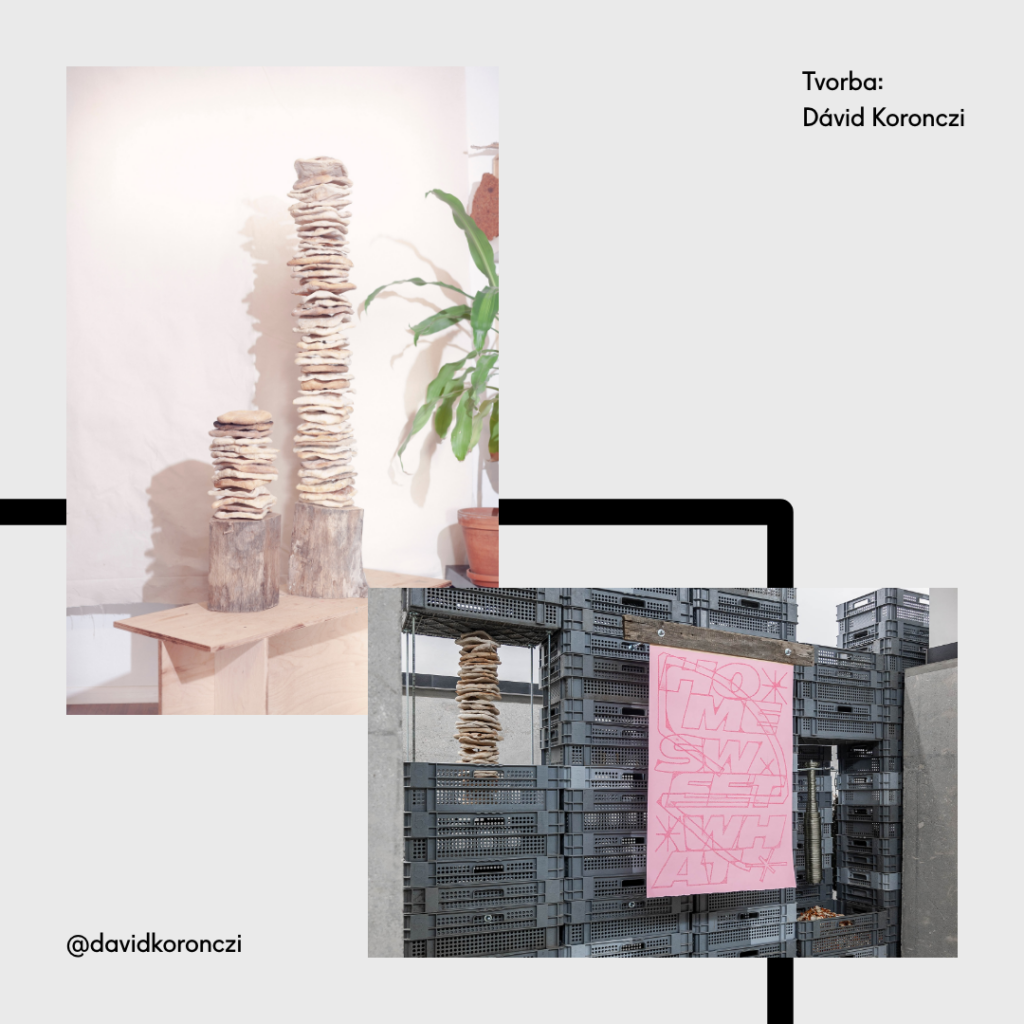
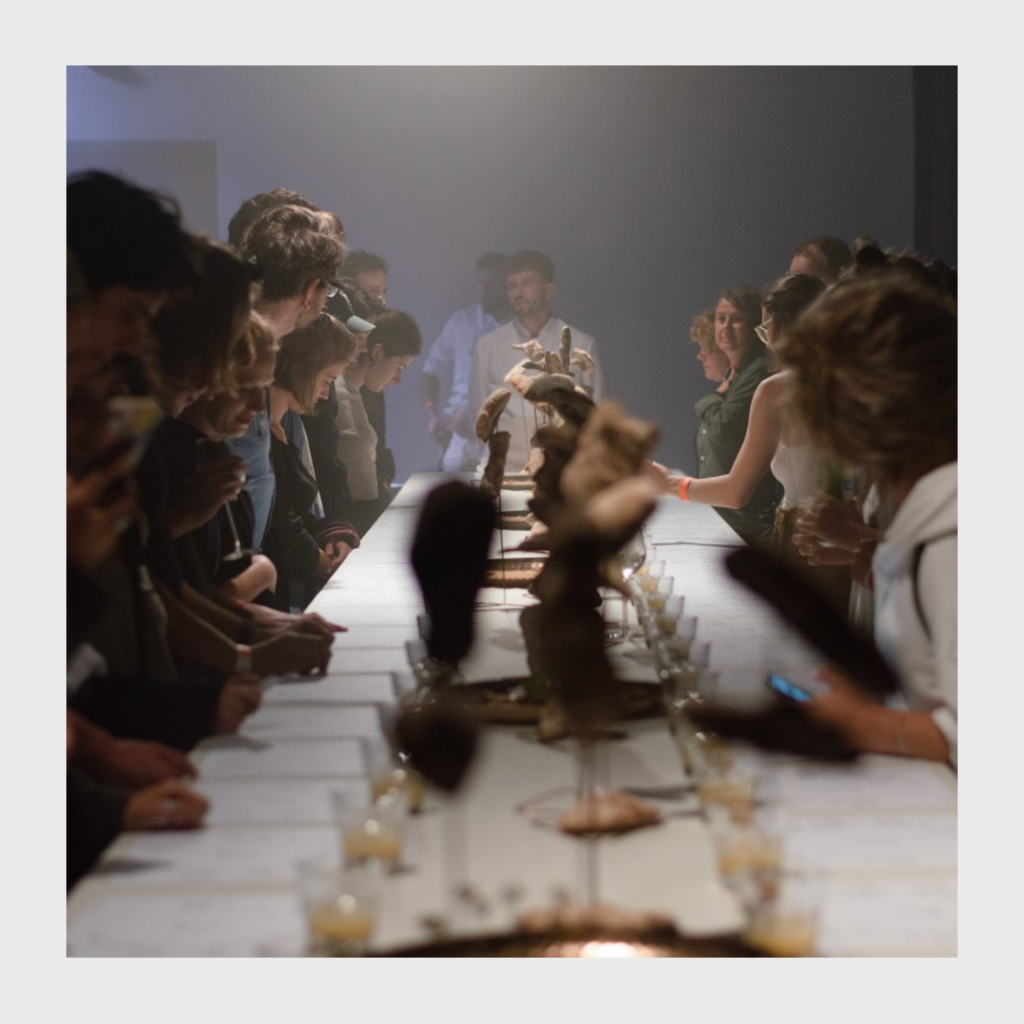
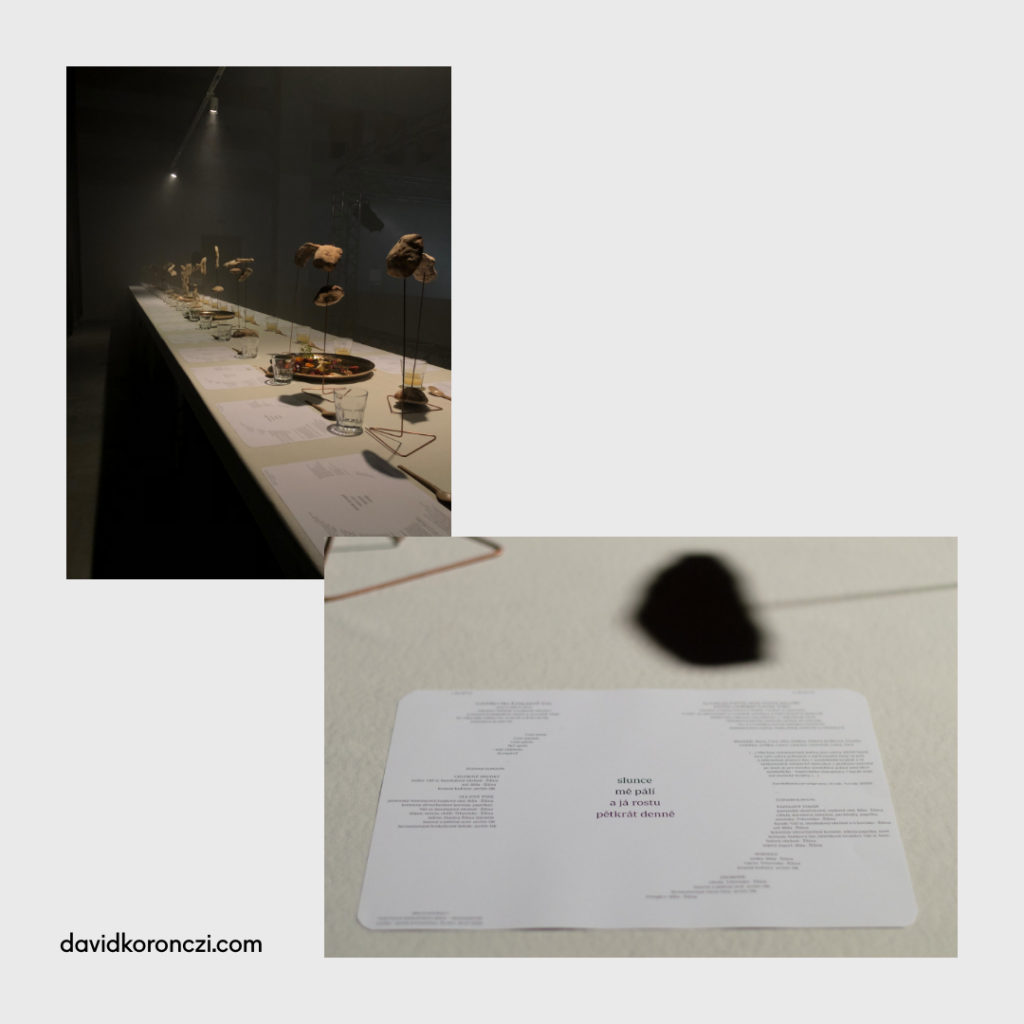
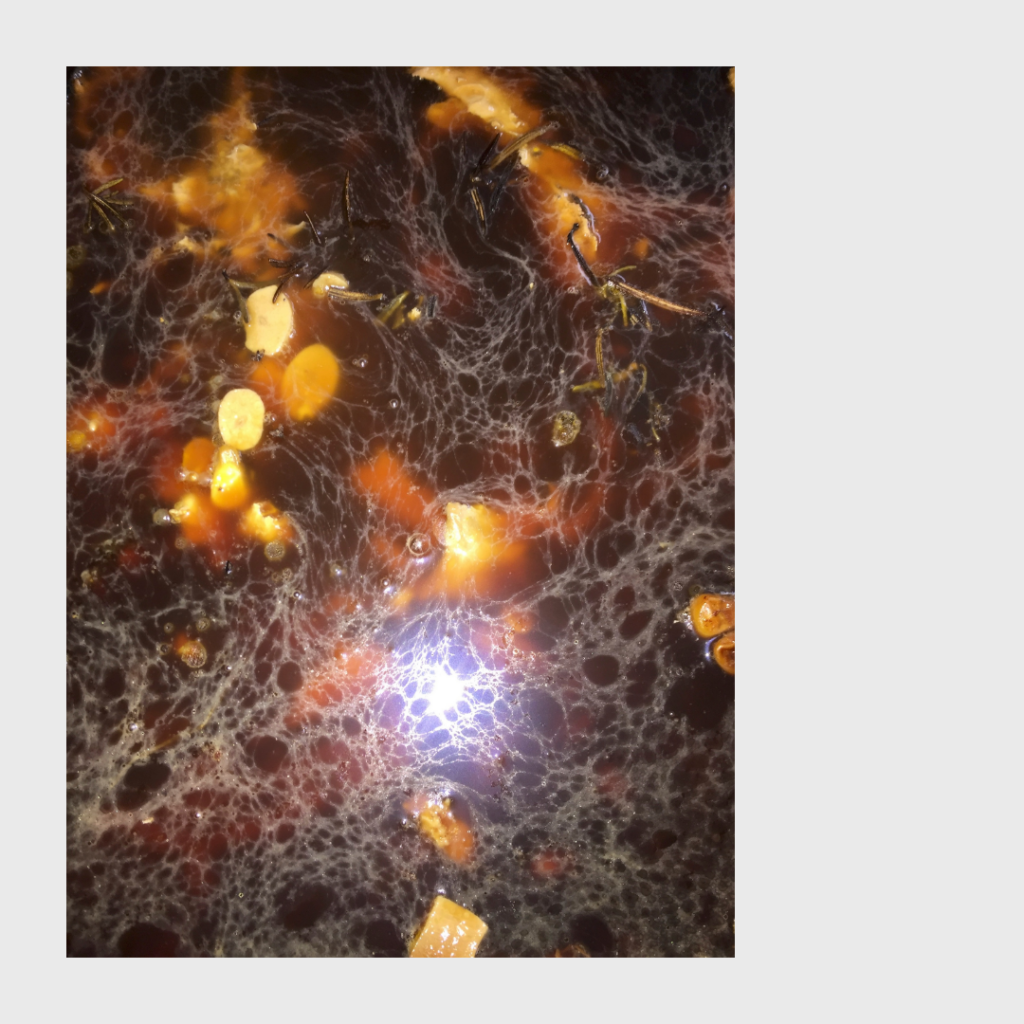
His creative interests are artistic practices that deal with gastro-history, agriculture, food as form or as content. He loves gardens, edible plants, cooking, and he yearns for art. He uses the combination of these passions to try to tell stories of sustainability, justice, love (not only romantic love, mind you!!!), childhood and curiosity.
In art and theory that deal with the world, he values the fact that they help him better understand his position, body and thoughts within the densely woven webs of planetary relationships. You can find his works, or some of them, at www.davidkoronczi.com or on IG: @davidkoronczi

You can also meet Dávid live as early as next Wednesday, 9 November 2022, from 17:00 at an online workshop! Together we will look at the theme of food in art. Let yourself be inspired.
The programme is intended for young people aged 14–19, and for everyone who is curious. The workshop is free and will take place online via the Zoom app. You can reserve your place at: vendy.kovacova@sng.sk The number of places is limited!
…
At the beginning of October, together with the Institute for Active Citizenship, we prepared a methodological workshop (hereinafter IPAO), which highlighted the mutual overlaps between art and civic awareness on the topic of Food, which is this year’s competition theme of Do You Have an Artistic Gut?. We decided to introduce their activities to you in more detail, because we recognize how important it is to develop civic awareness among children, young people and adults alike.

IPAO was founded by Jana Feherpataky-Kuzmová and, together with her team, she cares about where our society, its values, and the level of democracy and open society within it are heading. They direct their activities straight into the field, but they also work systemically with schools, state and public administration, other non-governmental non-profit organizations, companies and the media, while also trying to be an inspiration for the wider public. The projects they are developing are: Schools That Change the World and the Initiative for Civic Education, which you may have already come across.

Janka told us that art “helps her perceive things from different perspectives, reflect more deeply on social developments, and also gain new energy. Although the topic of food may seem all too ‘ordinary’ and everyday, that is precisely where its strength lies, as was shown at our workshop, and I believe it will also be reflected in the competition entries. What we take for granted is, for many people, a precious and even inaccessible commodity. The fact that we perceive different preferences in food also connects us. What is meant to bring us pleasure can also be a tool of manipulation. Food is one of the most essential human needs, and therefore it is also a civic topic.”
Thank you to Janka for the interview and we look forward to further collaborations! You can learn more about IPAO’s projects at www.ipao.sk, and also on LinkedIn.
…
At the end of the school year, we would also like to introduce the creator of our traveling award Do You Have an Artistic Gut? Katarína Defeo Fiúza Siposová.

Katarína comes from Dunajská Streda, is a graduate and doctoral student of the Academy of Fine Arts and Design in Bratislava, in the field of metal and jewelry, and a Fulbright scholarship recipient at the State University of New York. She continues to work with jewelry in her independent artistic practice (because jewelry is not just a display case full of gold things), on the theoretical level through research into the social value of the personal object (www.sperkstret.sk/vyskum), by co-organizing the largest platform dedicated to author jewelry in Slovakia—the international conference Šperkstret—and on the commercial level under the brand Big tiny dot, which is devoted to the aspect of jewelry that fascinates Katka greatly: the expression of a bond and connection between people close to one another.

Before maternity leave, Katarína spent a longer period working full-time in gallery education. She came to this field by chance, during her doctoral studies at VŠVU, when she was invited to lead a workshop organized by the SNG Gallery Education Department. It was a new creative challenge for her, and it still is today. Brainstorming programs, the artistic handling of a theoretical starting point, the thoughts and ideas behind our programs (they are not just little workshops) are a stimulating form of problem-solving that she enjoys, and of course the work and responsiveness of the group she works with is another humanly and pedagogically interesting element of this work.

Although Katarína is not part of the organizational team of the competition Máš umelecké črevo?, she was nevertheless present at its beginnings in connection with the creation of the original prize, which each year goes to the school of the winning team.
The MUČ? competition really appealed to her with its idea and framework, and she is very glad that she could be part of it and create a prize that grows together with the competition.
We thank Katka for the interview and look forward to her return to the office!
…
We are gradually revealing all the members of the team behind the educational platform Máš umelecké črevo?. Today we would like to introduce you more closely to the second of the competition organizers – Vendy Kováčová.

Vendy grew up, studied, and also works in Bratislava. She was drawn to art from childhood, but she only began to devote herself to this field after completing business academy, by studying art history and theory at the Faculty of Arts of Comenius University in Bratislava. She remained in the “world of art” after school as well, in the form of employment at SNG. In her free time, she devotes herself to analogue photography and writing poetry (which does not rhyme!), and recently she began studying graphic design so that she would finally feel truly complete. 🙂 You can follow her on IG: @laliovnik.tulipanokvety and @tulipan.laliovity

Vendy’s path to gallery education was more winding, because after school she first worked in the marketing department, where she gradually got a taste of gallery education, also in connection with completing supplementary pedagogical studies, a field she now devotes herself to fully. This work, or rather this discipline, won her over because it serves as a link between specialists in the field of art and the public. And her role is precisely to mediate artistic content to the public – to all age groups and in various forms! And she really enjoys that, also thanks to the fact that the programs produced by @edu.sng are experiential in nature and provide the audience with space to express themselves and to connect art with life and with further knowledge from other scientific fields as well.

Vendy was part of the Máš umelecké črevo? platform, albeit to a lesser extent, even while working in the Marketing Department. She considers the aforementioned project important also because she perceives adolescence as a very sensitive period, and she is glad that, together with Barbora Tribulová, she is able to provide space for expression, reflection, personal growth, and support for young people. At the same time, she is always curious to see what projects the teams will create for the gallery spaces.
She perceives freedom of choice as precious, often taken for granted. The year-long duration of the competition with this theme also allows her to feel gratitude for it and provides space for reflection.
We thank Vendy for the interview!
…
We are gradually revealing all the members of the team behind the educational platform Máš umelecké črevo?. Today we would like to introduce you more closely to one of the competition organizers – Barbora Tribulová.

Barbora’s path to the gallery was quite winding – she originally attended a secondary grammar school focused on natural sciences, and her parents imagined that she would end up, for example, at the Faculty of Mathematics, Physics and Informatics. But at that time she became so interested in literature, thanks to her teacher, that she grew enthusiastic about studying art history. Even though many people shook their heads and asked, “what are you going to do with that,” she decided to follow this path and studied Art History at the University of Trnava and completed her doctorate at VŠVU. While still a student, she began teaching at a secondary art school, also working in a gallery, and later switched from teaching at a secondary school to VŠVU, where she taught for three years and worked as a researcher. In the meantime, she was still employed at the gallery as well, and besides all that she also managed to have three children!

Barbora is currently employed full-time as a gallery educator at SNG in Bratislava. She became enthusiastic about this work because she passionately enjoys mediating art to all target groups. (Starting with toddlers!) In the gallery she found a great team of people with whom many new projects can be successfully carried out. As a great idealist, she imagines the gallery as a place where the general public will enjoy spending their free time, and that this is precisely the path toward cultivating our culture – by making art truly accessible to everyone. For her, this is also the greatest challenge. She is inspired above all by art (and not only visual art), but also by various pedagogical approaches based on respect. And, of course, by similarly focused institutions, organizations, and people. The work of a gallery educator is, however, also fairly demanding: it requires orientation in art theory and art history in interdisciplinary contexts, while at the same time the work also requires pedagogical skills and the ability to communicate clearly and engagingly and to guide different age groups through exhibitions. Ideally also with a good command of English. At first glance, the educational programs at SNG may look playful, but every step has its reason and logic and leads to a set goal, while the program must be attractive enough for people to want to return. Our work is also about knowing how to present ourselves.

Barbora joined the Slovak National Gallery also because of the project Do You Have an Artistic Gut?, so she has known it since its beginnings in Slovakia.
What interested her most about this project was that it is not only a competition, but also education. While working at a secondary art school, she had experience with several competitions to which student works were regularly submitted, but the process was always the same – in a specialized subject class, the whole group was given an assignment and the best works were sent to the competition. If they did not win, the kids never received any feedback and had no idea what projects, apart from the winning ones, had been in the running. Moreover, the people who evaluated the works never talked to them; they had no opportunity to present their work to them, and no workshops or consultations were held either. The competition Do You Have an Artistic Gut? has all of this, and in addition also the experience of defending one’s own opinion and approach in front of peers. That is why Barbora finds the competition very appealing. Another great added value is its international character – seeing how the annual theme is considered in neighboring countries. This year’s theme, Freedom of Choice, was proposed by Barbora herself, so it is quite close to her. She perceives freedom of choice as “something many of us take as a right, but few as a privilege or responsibility. Adolescence is a very suitable time for asking questions and seeking answers connected with this topic.”
Thank you to Barbora for the interview and for a deeper dive into her private life and work! I look forward to more projects together.
…
Every year, the Do You Have an Artistic Gut? competition has its own visual identity. In previous years, we collaborated with graphic designers Eva Benková and Ivana Palečková. Our newest graphic addition to the team is Adrián Dvorský! Meet him.

Adrián is from Banská Bystrica, where he studied graphic design at SOŠ-IT. During his studies, he did an internship at the digital agency Okto.digital and then worked there for a year. This experience was very educational for him, and he met great people there. Alongside work, he began preparing for university entrance exams. He is currently in his first year at VŠVU in the Department of Visual Communication. And we are keeping our fingers crossed for him!
The work of a graphic designer appealed to Adrián Dvorský because of the feeling he experiences when creating: “when I sit down at my white desk, put on Matej Vojtuš’s playlist and start arranging something on the monitor, I know I’m in the right place. From the beginning, there was a fascination with simplicity, shape, colour…” Adrián enjoys making decisions, solving problems and finding the right functional balance – “like when you lie down in bed in the evening, cover yourself up and toss the duvet and yourself around until it is just as it should be.”
Adrián draws inspiration from the graphic design around him, since it is almost everywhere. In addition, he follows many skilled
graphic designers on IG. He really likes, for example, the work of Ivana Palečková, as well as others. The last three months, since he became a student at VŠVU, have been great for him. The people he follows and admires are suddenly sitting opposite him, looking at and commenting on his designs. In his work, generating design, type design and 3D are challenges for him. “But…, on the other hand, everything is a challenge for me, since I still consider myself a graphic-design insect and I have only been dealing with these issues for a short time. It will still be a long journey, but I’m really looking forward to it.”
We asked Adrián more…
How did you come to work as a graphic designer for the Do You Have an Artistic Gut? platform?
Back in the 4th year of secondary school, together with my classmate Jakub Ďurian, under the guidance of teacher Marianna Mlynárčiková, we took part in the Do You Have an Artistic Gut? competition, which we managed to win, and the graphic design of our project was also awarded. Afterwards, we received an offer of cooperation from the competition organizers – to expand the competition platform to IG within SOŠ-IT. Together with Jakub, with the help of Marianna Mlynárčiková, we wrote up thematic areas and designed the visual of a gut stretching across the entire profile. Later, I was approached to see whether I would like to collaborate as graphic support for the 6th year of the Do You Have an Artistic Gut? competition.
Is this year’s theme Freedom of Choice close to you? If so, in what way?
Freedom of choice is the alpha and omega for me. It gives me the opportunity to make decisions and take responsibility, whether in design or in life as such.
Thank you for the interview, and we are very happy that Adrián accepted our offer of cooperation, because who knows the Do You Have an Artistic Gut? competition better than someone who has taken part in it himself? 🙂
You can follow Adrián on IG: @adriandvorsky_
…
We are delighted to introduce you to the artist Kristián Németh, with whom we carried out interesting workshops during the autumn of 2021.

Kristián Németh studied Intermedia at the Academy of Fine Arts and Design, where he has just completed his doctoral studies, and he was a finalist in last year’s Oskár Čepan Award. In his work, through material, he reflects on and criticizes the mechanisms and paradoxes of certain institutions (especially the church) operating in today’s democratic society.
An interesting fact is that before VŠVU he also studied landscape architecture.
We asked Kristián how close the competition theme Freedom of Choice is to him and whether it can also be found in his work.
In addition, we were interested in how he came up with the idea of working with candles and why he enjoys this type of material.
The competition theme – freedom of choice – is close to me, as in my work I often deal with institutional criticism of the church. Through its dogmas, the church itself often denies people this possibility.
Since I had a Christian upbringing, I also received my First Holy Communion. During this act, as I was holding a candle in my hand, it bent slightly due to the heat. It struck me as an interesting moment that carries many symbols and connotations. Wax as a material is fascinating because it can also turn into a liquid. All that is needed is to reach the required temperature and we can reshape it and leave fingerprints in it.
You can find more about Kristián’s work at @nemeth_kristian or in the portfolio available on the Oskár Čepan Award website (www.oskarcepan.sk.) He is currently already working intensively on a publication and a website that will reveal more about his work.

…
This year, the art platform Do You Have an Artistic Gut? is represented by the global law firm Taylor Wessing. We are delighted with this new cooperation and thank them for their financial support! To help you better understand the aim of our cooperation, we would like to introduce Taylor Wessing to you in more detail. We therefore interviewed one of the firm’s founders – Radovan Pala.

Taylor Wessing provides legal advice to innovative and creative people and businesses, advising in those areas of law that entrepreneurs encounter in their activities, and working to ensure that in each of them there are colleagues who are experts. Law is a field they uncompromisingly love, and moving within it fulfils them. They enjoy learning about the problems and challenges their clients face in their business and looking for the best possible solutions for them. At the same time, law is an area in which they seek opportunities to be creative and to help clients fulfil their ideas and visions. At the same time, however, they care deeply about the environment in which we live and work. That is why they are also actively involved in many activities they consider beneficial for society and for the environment in which they operate.
Taylor Wessing is one of the largest law firms in Slovakia. It was founded in 2004 – together with foreign partners – by two classmates from secondary school and university, Andrej Leontiev and Radovan Pala. They founded the firm with the vision that legal services can be provided at the highest level without having to compromise on the values of integrity and mutual respect. Also without “succumbing” to their own importance and feeling a kind of “legal superiority”, which is a common phenomenon in the legal profession. At the beginning, they were a very small firm made up of several male and female colleagues. Today it is a living organism of almost 40 people who meet, talk and persuade one another every day. They address legal issues in teams where expertise in legal fields is concentrated, for example in the area of intellectual property law, labour law or commercial law.
The Taylor Wessing team is diverse and full of unique, occasionally stubborn personalities. They have different interests, opinions and views of the world. What unites them is the conviction that truly good legal advice (like any other service) must be linked to dedication to service and integrity. It is precisely working in a team that gives them the courage, desire and strength to move forward. Without the people who make it up, the Taylor Wessing “brand” would be just an empty shell.

Why did the law firm decide to support the Do You Have an Artistic Gut? project? Radovan Pala – one of the founders of the Taylor Wessing law firm – answers. And is art part of his life?
I am convinced that there is a barely visible but important relationship between beauty and law. There is a certain, though probably indefinable, correlation between the ability to perceive beauty and to be just. Both are based on a certain sense of harmony and are connected by the experience of a similar feeling of inner satisfaction when a person sees or even creates something that is either beautiful or just. I am convinced that someone who learns to perceive and internalise beauty is deeply shaken when they see something grossly unjust and at the same time feels an existential need to object to it and do something about it. And that is in fact also the answer to the question of why we are very glad to be able to support a competition that encourages young people to create and to become acquainted with art.
Both my parents are glass artists – sculptors, so I have an intimate relationship with visual art. Art is also very important to me in other forms, however, especially in the form of literature – books are one of the greatest joys to which I have devoted myself for a long time and, together with my wife, I think we have quite an extensive and diverse library.
My relationship with art has at least two levels – first of all, because my parents, Štěpán Pala and Zora Palová, are artists whose creative mission fulfils them and which they engage in fully every day, I always took it as a given and a natural thing that in life I would do something I enjoy and truly love. The creative work of artists is very demanding and has various pitfalls, but unlike, for example, office work, it is only rarely associated with a feeling of monotony, with the sense that I am doing something that has no meaning, something I do only out of duty, or only in order to make a living.

Freedom of choice is an immensely interesting topic, because from a legal point of view it contains two interesting concepts that are very closely intertwined – freedom and choice. Between freedom and choice flows the river of social order and consensus, which determines the degree of personal freedom and the real possibilities of choice (in the case of dictatorships, a discussion about freedom of choice has no place). Freedom of choice is also linked to a cornerstone of law, and that is responsibility. In other words, if I have the freedom to make decisions, I also bear responsibility for what I have chosen.
Writing about the substance of these concepts and their relationship, even from a narrowly legal perspective alone, would fill many books that would never agree. I will therefore try only very briefly to name what makes them interesting to me. Freedom from external interference and restrictions (for example by the state) is a necessary precondition for choice, but it is often not enough for a genuine choice. Freedom can also exist passively, without being manifested outwardly. Choice is always an outward manifestation of the existence of freedom and usually also elicits a response from the surrounding environment. Freedom is not only about no one directly – for example through state power – actively preventing you from deciding in a certain way; it is also an internal category related to the consequences of your choice – for you and for society. You can freely decide (choose) to commit a crime as well, but if you are aware of what the harmfulness of the crime consists in and of the possible consequences in the form of a subsequent restriction of freedom, you will rather not choose this option. If, however, you know that state power is weak and the risk of being caught committing a crime is low, the degree of your freedom is higher, but at the expense of others. Another factor is social pressure – if expectations of a negative reaction from those around you as a consequence of the choice are high, freedom may formally exist, but it will not be practically realised in the form of concrete decisions. For a choice to be truly free, you must moreover have – from the perspective of the life you live – real options to choose from. Freedom of choice is therefore not always connected only with evaluating consequences and the reaction of those around you, but also with the objective situation of the person making the decision. You can freely decide that you want to study at Oxford, but if you come from a settlement in eastern Slovakia, this choice is inaccessible. Freedom of choice is thus always connected with the external environment, the accessibility of the choice, and the formal existence of freedom does not always mean something positive.
More about Taylor Wessing here.
You can also follow law in its everyday life at: @taylorwessing_bratislava and Radovan Pala on LinkedIn.
And if you like listening to podcasts, listen on Spotify to the podcast (s)Právne naladení – about legal topics in an understandable and interesting way!
…
This year’s chair of the jury of the Do You Have an Artistic Gut? competition is Jana Kapelová! We are very happy that she accepted our invitation and became part of the team for the 6th edition. We would like to introduce her to you in more detail.
Jana Kapelová is a visual artist, educator and curator. She studied at the Faculty of Education of Trnava University, the Faculty of Fine Arts in Banská Bystrica, the Academy of Fine Arts in Prague and the Academy of Fine Arts and Design in Bratislava. She has taught at the Academy of Fine Arts in Prague and currently co-leads the Intermedia Studio at the Academy of Fine Arts and Design in Bratislava. In 2014 she became the winner of the Oskár Čepan Award. She has exhibited at several solo and group exhibitions in Slovakia, Hungary, Austria, the Czech Republic, Romania, Germany, Switzerland, the USA, Japan, Sweden… Her works are represented in the collections of Slovak galleries.

In her work, Jana Kapelová deals with themes such as work and precarisation, free time and self-realisation, and the influence of the social and cultural environment, upbringing and education on individuals and society. She was an active member of the initiative Twenty Years Since the Velvet Revolution Did Not Happen.

This year’s competition theme, Freedom of Choice, runs through Jana Kapelová’s entire body of work. In her projects, she often explores the boundaries between personal freedom and established patterns of behaviour in society. That is, how in our lives, whether during our studies or at work, but also in the contradictory moments of our society, we decide whether to choose the path of self-realisation, civic responsibility, tolerance or mutual respect.
We will be able to meet her during the semi-final and final rounds of the competition!
You can read more about Jana Kapelová and her work here.